Code
pacman::p_load(ggiraph, plotly, DT, patchwork, tidyverse)In this exercise, beside tidyverse, four R packages will be used. They are:
pacman::p_load(ggiraph, plotly, DT, patchwork, tidyverse)In this section, Exam_data.csv provided will be used. Using read_csv() of readr package, import Exam_data.csv into R.
exam_data <- read_csv("data/Exam_data.csv")ggiraph is an htmlwidget and a ggplot2 extension. It allows ggplot graphics to be interactive.
Interactive is made with ggplot geometries that can understand three arguments:
If it used within a shiny application, elements associated with an id (data_id) can be selected and manipulated on client and server sides. Refer to this article for more detail explanation.
Below shows a typical code chunk to plot an interactive statistical graph by using ggiraph package.
Notice that the code chunk consists of two parts.
girafe() of ggiraph will be used to create an interactive svg object.p <- ggplot(data=exam_data,
aes(x = MATHS)) +
geom_dotplot_interactive(
aes(tooltip = ID),
stackgroups = TRUE,
binwidth = 1,
method = "histodot") +
scale_y_continuous(NULL,
breaks = NULL)
girafe(
ggobj = p,
width_svg = 6,
height_svg = 6*0.618
)Notice that two steps are involved.
geom_dotplot_interactive()) will be used to create the basic graph.girafe() will be used to generate an svg object to be displayed on an html page.NOTE : By hovering the mouse pointer on an data point of interest, the student’s ID will be displayed.
We can also customise the content of the tooltip by including a list object as shown in the code chunk below.
# The first three lines of codes in the code chunk create a new field called tooltip.
#  At the same time, it populates text in ID and CLASS fields into the newly created field.
exam_data$tooltip <- c(paste0(
  "Name = ", exam_data$ID,
  "\n Class = ", exam_data$CLASS))

# Next, this newly created field is used as tooltip field.
p <- ggplot(data=exam_data,
       aes(x = MATHS)) +
  geom_dotplot_interactive(
    aes(tooltip = exam_data$tooltip),
    stackgroups = TRUE,
    binwidth = 1,
    method = "histodot") +
  scale_y_continuous(NULL,
                     breaks = NULL)
girafe(
  ggobj = p,
  width_svg = 8,
  height_svg = 8*0.618
)
NOTE : By hovering the mouse pointer on an data point of interest, the student’s ID and Class will be displayed.
Example below uses opts_tooltip() of ggiraph to customize tooltip rendering by add css declarations.
tooltip_css <- "background-color:white; #<<
font-style:bold; color:black;" #<<

p <- ggplot(data=exam_data,
       aes(x = MATHS)) +
  geom_dotplot_interactive(
    aes(tooltip = ID),
    stackgroups = TRUE,
    binwidth = 1,
    method = "histodot") +
  scale_y_continuous(NULL,
                     breaks = NULL)
girafe(
  ggobj = p,
  width_svg = 6,
  height_svg = 6*0.618,
  options = list(    #<<
    opts_tooltip(    #<<
      css = tooltip_css)) #<<
)
Notice that the background colour of the tooltip is black and the font colour is white and bold.
Refer to Customizing girafe objects to learn more about how to customise ggiraph objects.
In this example, a function is used to compute 90% confident interval of the mean. The derived statistics are then displayed in the tooltip. Code chunk below shows an advanced way to customise tooltip.
tooltip <- function(y, ymax, accuracy = .01) {
  mean <- scales::number(y, accuracy = accuracy)
  sem <- scales::number(ymax - y, accuracy = accuracy)
  paste("Mean maths scores:", mean, "+/-", sem)
}

gg_point <- ggplot(data=exam_data,
                   aes(x = RACE),
) +
  stat_summary(aes(y = MATHS,
                   tooltip = after_stat(
                     tooltip(y, ymax))),
    fun.data = "mean_se",
    geom = GeomInteractiveCol,
    fill = "light blue"
  ) +
  stat_summary(aes(y = MATHS),
    fun.data = mean_se,
    geom = "errorbar", width = 0.2, linewidth = 0.2
  )

girafe(ggobj = gg_point,
       width_svg = 8,
height_svg = 8*0.618)Code chunk below shows the second interactive feature of ggiraph, namely data_id.
p <- ggplot(data=exam_data,
       aes(x = MATHS)) +
  geom_dotplot_interactive(
    aes(data_id = CLASS),
    stackgroups = TRUE,
    binwidth = 1,
    method = "histodot") +
  scale_y_continuous(NULL,
                     breaks = NULL)
girafe(
  ggobj = p,
  width_svg = 6,
  height_svg = 6*0.618
)
NOTE :
In the example below, css codes are used to change the highlighting effect.
p <- ggplot(data=exam_data,
       aes(x = MATHS)) +
  geom_dotplot_interactive(
    aes(data_id = CLASS),
    stackgroups = TRUE,
    binwidth = 1,
    method = "histodot") +
  scale_y_continuous(NULL,
                     breaks = NULL)
girafe(
  ggobj = p,
  width_svg = 6,
  height_svg = 6*0.618,
  options = list(
    opts_hover(css = "fill: #202020;"),
    opts_hover_inv(css = "opacity:0.2;")
  )
)NOTE:
There are times that we want to combine tooltip and hover effect on the interactive statistical graph as shown in the code chunk below.
p <- ggplot(data=exam_data,
       aes(x = MATHS)) +
  geom_dotplot_interactive(
    aes(tooltip = CLASS,
        data_id = CLASS),
    stackgroups = TRUE,
    binwidth = 1,
    method = "histodot") +
  scale_y_continuous(NULL,
                     breaks = NULL)
girafe(
  ggobj = p,
  width_svg = 6,
  height_svg = 6*0.618,
  options = list(
    opts_hover(css = "fill: #202020;"),
    opts_hover_inv(css = "opacity:0.2;")
  )
)
NOTE : Elements associated with a data_id (i.e CLASS) will be highlighted upon mouse over. At the same time, the tooltip will show the CLASS.
An example of onclick argument of ggiraph provides hotlink interactivity on the web.
exam_data$onclick <- sprintf("window.open(\"%s%s\")",
"https://www.moe.gov.sg/schoolfinder?journey=Primary%20school",
as.character(exam_data$ID))

p <- ggplot(data=exam_data,
       aes(x = MATHS)) +
  geom_dotplot_interactive(
    aes(onclick = onclick),
    stackgroups = TRUE,
    binwidth = 1,
    method = "histodot") +
  scale_y_continuous(NULL,
                     breaks = NULL)
girafe(
  ggobj = p,
  width_svg = 6,
  height_svg = 6*0.618)
NOTE :
Example below shows coordinated multiple views methods has been implemented in the data visualisation below.
Notice that when a data point of one of the dotplot is selected, the corresponding data point ID on the second data visualisation will be highlighted too.
In order to build a coordinated multiple views as shown in the example above, the following programming strategy will be used:
The data_id aesthetic is critical to link observations between plots and the tooltip aesthetic is optional but nice to have when mouse over a point.
p1 <- ggplot(data=exam_data,
       aes(x = MATHS)) +
  geom_dotplot_interactive(
    aes(data_id = ID),
    stackgroups = TRUE,
    binwidth = 1,
    method = "histodot") +
  coord_cartesian(xlim=c(0,100)) +
  scale_y_continuous(NULL,
                     breaks = NULL)

p2 <- ggplot(data=exam_data,
       aes(x = ENGLISH)) +
  geom_dotplot_interactive(
    aes(data_id = ID),
    stackgroups = TRUE,
    binwidth = 1,
    method = "histodot") +
  coord_cartesian(xlim=c(0,100)) +
  scale_y_continuous(NULL,
                     breaks = NULL)

girafe(code = print(p1 + p2),
       width_svg = 6,
       height_svg = 3,
       options = list(
         opts_hover(css = "fill: #202020;"),
         opts_hover_inv(css = "opacity:0.2;")
       )
) Plotly’s R graphing library create interactive web graphics from ggplot2 graphs and/or a custom interface to the (MIT-licensed) JavaScript library plotly.js inspired by the grammar of graphics. Different from other plotly platform, plot.R is free and open source.
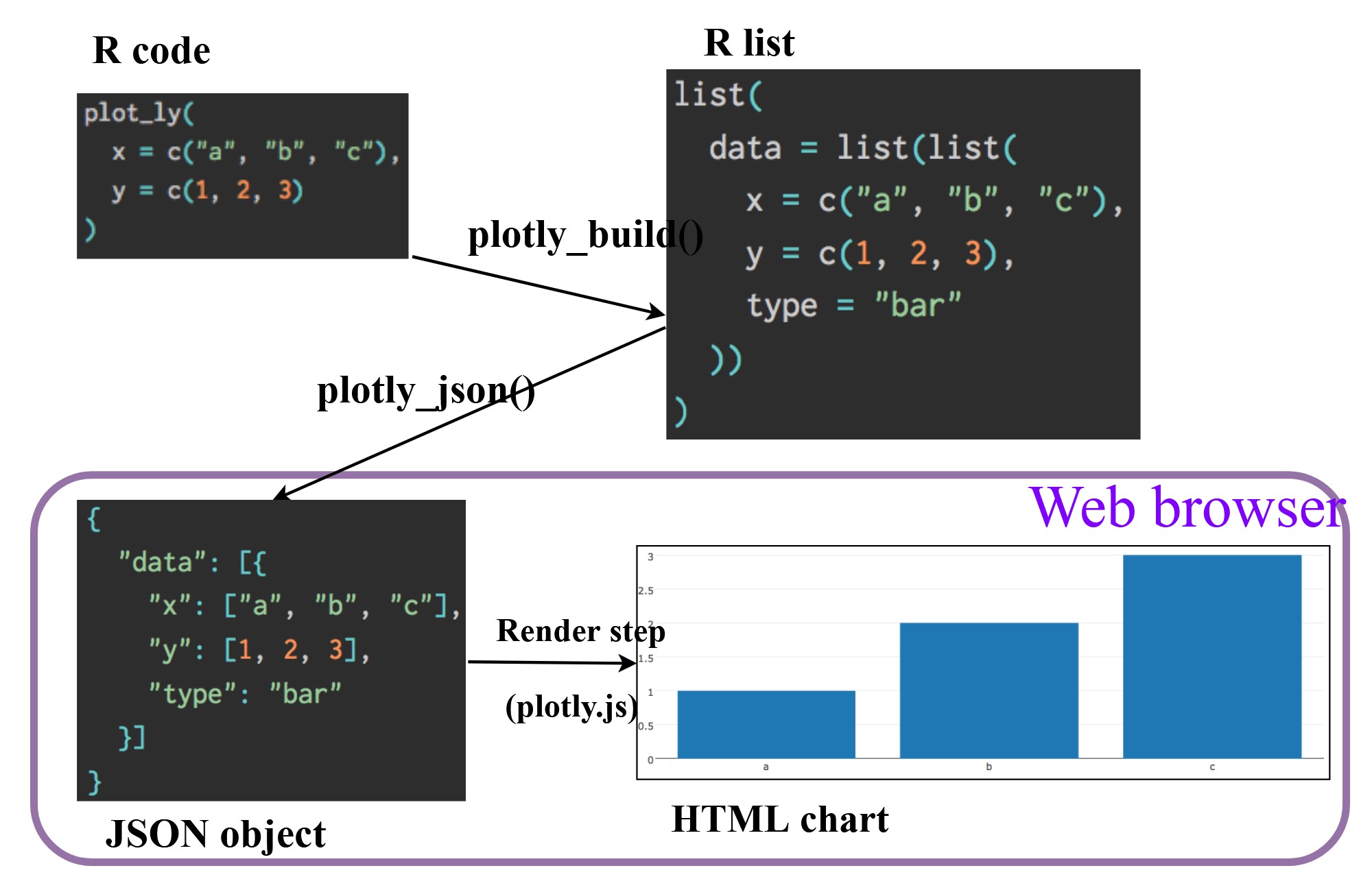
There are two ways to create interactive graph by using plotly, they are:
plot_ly(), andggplotly()plot_ly() methodThe example below shows a basic interactive plot created by using plot_ly().
plot_ly(data = exam_data,
             x = ~MATHS,
             y = ~ENGLISH)
No trace type specified:
Based on info supplied, a 'scatter' trace seems appropriate.
Read more about this trace type -> https://plotly.com/r/reference/#scatterNo scatter mode specifed:
Setting the mode to markers
Read more about this attribute -> https://plotly.com/r/reference/#scatter-modeplot_ly() methodThe example below uses the color argument to map to a qualitative visual variable (i.e. RACE).
NOTE : Click on the colour symbol at the legend for filtering of the data by respective RACE.
plot_ly(data = exam_data,
        x = ~ENGLISH,
        y = ~MATHS,
        color = ~RACE,
        type="scatter")
No scatter mode specifed:
Setting the mode to markers
Read more about this attribute -> https://plotly.com/r/reference/#scatter-modeggplotly() methodThe example below plots an interactive scatter plot by using ggplotly().
NOTE : Notice that the only extra line you need to include in the code chunk is ggplotly().
p <- ggplot(data=exam_data,
            aes(x = MATHS,
                y = ENGLISH)) +
  geom_point(size=1) +
  coord_cartesian(xlim=c(0,100),
                  ylim=c(0,100))
ggplotly(p)The creation of a coordinated linked plot by using plotly involves three steps:
highlight_key() of plotly package is used as shared data.NOTE : Click on a data point of one of the scatterplot and see how the corresponding point on the other scatterplot is selected.
d <- highlight_key(exam_data)
p1 <- ggplot(data=d,
            aes(x = MATHS,
                y = ENGLISH)) +
  geom_point(size=1) +
  coord_cartesian(xlim=c(0,100),
                  ylim=c(0,100))

p2 <- ggplot(data=d,
            aes(x = MATHS,
                y = SCIENCE)) +
  geom_point(size=1) +
  coord_cartesian(xlim=c(0,100),
                  ylim=c(0,100))
subplot(ggplotly(p1),
        ggplotly(p2))
Thing to learn from the code chunk:
highlight_key() simply creates an object of class crosstalk::SharedData.Crosstalk is an add-on to the htmlwidgets package. It extends htmlwidgets with a set of classes, functions, and conventions for implementing cross-widget interactions (currently, linked brushing and filtering).
DT::datatable(exam_data, class= "compact")Example below is used to implement the coordinated brushing shown above.
d <- highlight_key(exam_data)
p <- ggplot(d,
            aes(ENGLISH,
                MATHS)) +
  geom_point(size=1) +
  coord_cartesian(xlim=c(0,100),
                  ylim=c(0,100))

gg <- highlight(ggplotly(p),
                "plotly_selected")

crosstalk::bscols(gg,
                  DT::datatable(d),
                  widths = 5)
Setting the `off` event (i.e., 'plotly_deselect') to match the `on` event (i.e., 'plotly_selected'). You can change this default via the `highlight()` function.Things to learn from the code chunk:
highlight() is a function of plotly package. It sets a variety of options for brushing (i.e., highlighting) multiple plots. These options are primarily designed for linking multiple plotly graphs, and may not behave as expected when linking plotly to another htmlwidget package via crosstalk. In some cases, other htmlwidgets will respect these options, such as persistent selection in leaflet.bscols() is a helper function of crosstalk package. It makes it easy to put HTML elements side by side. It can be called directly from the console but is especially designed to work in an R Markdown document. Warning: This will bring in all of Bootstrap!